
Cheap Globalization Is Over
Sanctions are a political labor policy.

Alpha rarely comes from the headline. By the time the headline exists, the market has usually already decided what it thinks.
The real money is made earlier… when capital is quietly being forced to move and most people still think nothing has changed. That is the work. I track where capital is forced to move before markets fully price why, and workforce is simply where the evidence shows up first.
That distinction matters because too many people hear the word “workforce” and immediately assume HR, hiring trends, or labor-market commentary. That is not the game. I am not studying jobs for the sake of jobs. I track execution risk… where companies, sectors, and entire economies quietly reveal what they actually believe about the future through who they protect, who they cut, where they are willing to overpay, and what they refuse to stop funding when everything else is being compressed.
I’ve built this framework to identify execution risk months before layoffs, guidance revisions, and strategic resets became consensus. I was writing about Microsoft’s internal labor compression and AI capital protection before layoffs were publicly framed as an AI efficiency story. Same with Meta and others and I’m still being denied by the company comms teams. Well, fact is - I was right - about all of them. By the time the market called it restructuring, the org chart had already said it. White-collar compression showed up in role architecture long before headlines started debating layoffs, because the severance math was already visible in the workforce mix. The signal is rarely hidden… it is usually just ignored because most people are looking in the wrong place.
Most investors still analyze demand. I analyze coordination.
Markets are very good at pricing outcomes. They can model revenue growth, earnings revisions, margin expectations, policy headlines, and demand curves with impressive speed. What they consistently struggle to price is the narrow and often fragile path required to actually make those outcomes happen: engineering talent, supply-chain resilience, financing structures, compliance burden, manufacturing depth, logistics networks, regulatory survivability, and the institutional trust required to move from strategy to execution. The market loves the destination, butI care about whether the road still exists.
That is where real risk lives, and increasingly, that is where the best opportunities live too.
Sanctions, tariffs, trade wars, reshoring, energy security, defense spending, and AI infrastructure are usually treated like separate macro stories competing for attention. They are not separate stories at all… I want you to take that sentiment with you. All of this is symptoms of the same structural shift: the world is becoming more expensive to coordinate.
That is the real macro trade.
For two decades, the dominant operating model across global business was built on one assumption, that globalization would remain cheap enough, stable enough, and cooperative enough to support maximum efficiency. Companies optimized around frictionless movement: cheap labor, cheap capital, concentrated suppliers, outsourced complexity, lean inventories, and the belief that the system itself would remain dependable enough that efficiency was always the rational choice.
That model is breaking. Not because of one administration, one tariff announcement, or one geopolitical conflict, but because trust itself has become expensive. Supply chains are no longer just operational decisions; they are geopolitical decisions. Talent pipelines are no longer just recruiting questions; they are sovereignty questions. Financing is no longer neutral. Logistics is no longer invisible. Compliance is no longer a quiet back-office function.
Execution itself has become a premium asset and that changes where capital wins.
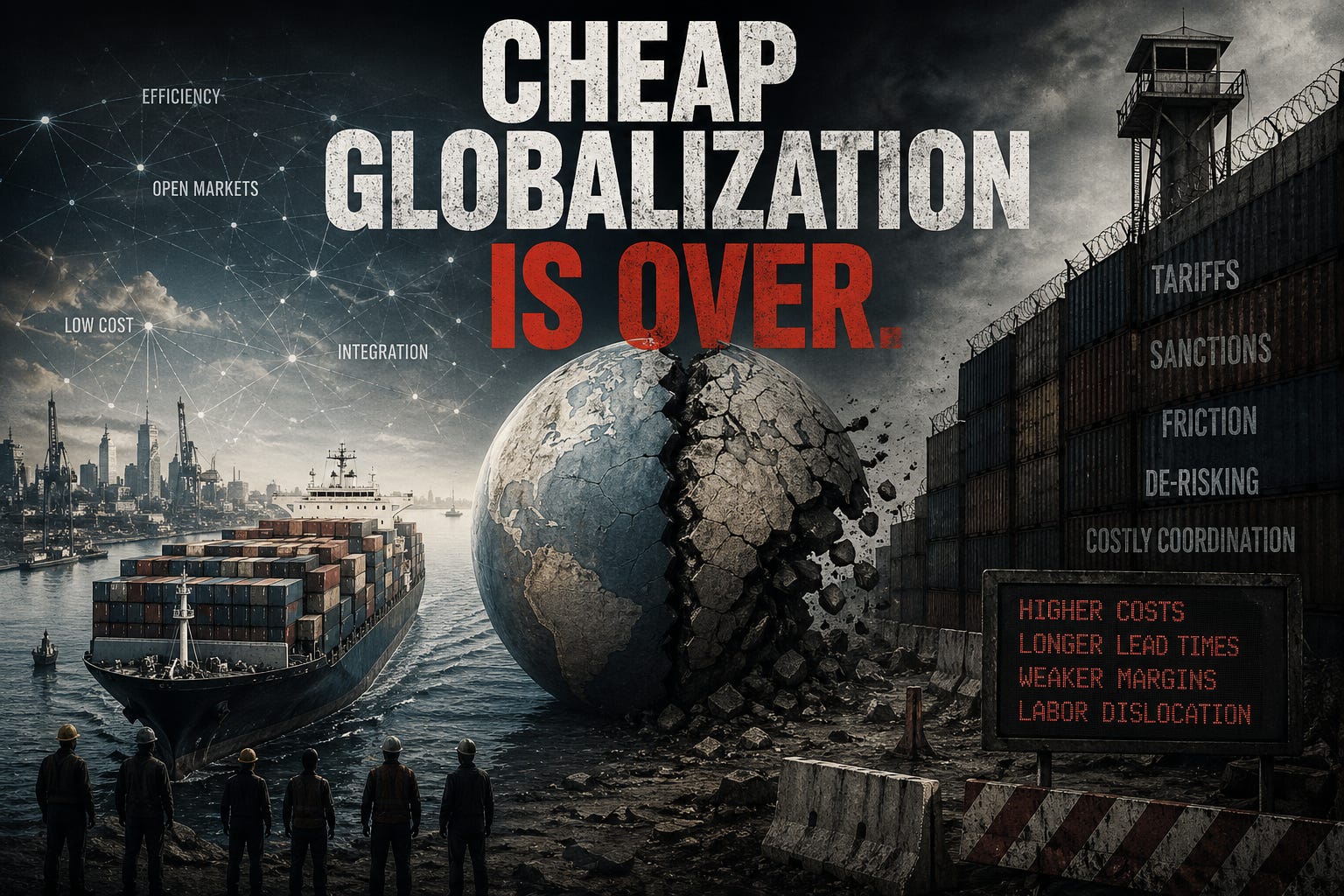
The real question is not whether sanctions are good or bad, whether tariffs are inflationary, or whether reshoring is patriotic. Those are downstream conversations. The real question is much simpler and much more important: which business models break when coordination gets expensive, and which ones become more valuable because of it?
The highest-risk companies in the next cycle will not be the ones with weak demand. They will be the ones built on assumptions of cheap coordination that no longer exist. That is how family offices, hedge funds, and serious long-duration capital should be thinking.
Because the next decade will not be defined by who has the best narrative. It will be defined by who can still execute when globalization stops being cheap. This is why I do not think sanctions are primarily a foreign policy story… and I know I go against every normal thought process- but sanctions are a political labor policy story.
People hear sanctions and think governments, oil, tariffs, and headlines. I think org charts, because sanctions do not eliminate cost… they relocate it. They move it around the system until someone with less leverage is forced to absorb it. Somewhere inside a company that used to operate with one supplier, one shipping route, and one financing structure, there is suddenly a need for three backup vendors, customs oversight, a legal review, trade compliance teams, supplier diversification, more inventory sitting on the balance sheet, and significantly more working capital just to move the exact same product sold last year.
Same product.
Same customer.
Same revenue target.
Completely different machine underneath it.
That is the hidden tax.
Most people only notice the final step, which is the consumer paying more at checkout and calling it inflation, but that is the end of the story, not the beginning. The first payer is almost always the corporation, because sanctions do not arrive inside a business as a dramatic geopolitical moment. They arrive as operational friction… new compliance requirements, alternate sourcing strategies, insurance changes, financing constraints, longer shipping routes, supplier redundancies, and sometimes an entirely new operating model required just to preserve the same revenue stream.
People think tariffs are the tax. They are not. The real tax is needing five extra teams just to move the same box from point A to point B.
Management then has to make a decision: do we pass the cost to consumers, accept lower margins, or cut somewhere else to protect earnings? That “somewhere else” is usually labor.
This is why inflation and layoffs are often the same story, just at different stages. Governments announce policy, corporations absorb the operational shock, consumers eventually pay through price, and workers often pay twice… first through inflation, then through restructuring when management decides that protecting margins matters more than protecting headcount.
That is not just social commentary, it is straight up a margin signal. That is why I watch payroll before I watch CPI.
Before sanctions show up cleanly in earnings, they show up in hiring behavior. Who is suddenly protecting trade compliance, supply-chain risk, manufacturing engineering, defense production, cybersecurity, customs, logistics, and regional finance while quietly compressing softer layers that no longer justify their cost?
Before costs show up in margins, they show up in org charts. That is where the truth starts leaking. and if you can see it there first, you are no longer reacting to earnings.
You are trading inevitability - sometimes 6-18 months ahead of time.
This is also why most people ask the wrong question about whether sanctions “work.” They ask whether sanctions stop behavior, as if capital responds like a switch being flipped. Usually, it does not.
Sanctions create friction. They raise costs, slow transactions, complicate financing, and make certain relationships politically expensive. That part is real. But friction is not the same thing as control, and capital does not like being told where it cannot go.
It usually finds another route.
That is why I do not think of sanctions as a stop sign. I think of them as a detour.
Oil still moves. Semiconductors still move. Rare earths still move. Money still moves. The route just gets longer, more expensive, and far less transparent.
That creates an entire second economy of middlemen… countries, banks, insurers, logistics hubs, and capital centers that suddenly become strategically critical because they sit in the new path. This is where many investors miss the opportunity. They focus on the country being sanctioned, while I am usually more interested in the companies and jurisdictions quietly making money from the reroute.
Shipping, trade finance, compliance-heavy banking, energy infrastructure, defense supply chains, industrial logistics, and capital routing, this is where margins hide and where capital compounds.
The real question is not whether sanctions worked. The real question is where the business went instead, because usually it did not disappear.
It just changed passports.
This is why places like the UAE, Switzerland, Singapore, India, Mexico, and selective Gulf markets matter so much. Not because they “won,” but because they became useful. Trade fragmentation rewards countries that can do one of five things: move goods, finance goods, insure goods, refine goods, or assemble goods. The winners are rarely the countries making the most noise. They are the places that become infrastructure.
The UAE is a perfect example. People hear UAE and think oil wealth, but the real advantage is routing power. Capital can stop there, restructure there, finance there, and redeploy from there. Commodities move through it. Private wealth moves through it. Cross-border business gets rebuilt there.
That is not just wealth.. it is so strategic it hurts and in a fragmented world, neutrality becomes infrastructure… that is why sovereign money cares and ask me the right questions.
Switzerland plays a similar role through capital stability, commodities, and private wealth. Singapore remains one of the cleanest coordination hubs in the world. Mexico benefits from nearshoring, but reshoring is not patriotic branding… it is a really brutal operations problem involving ports, power, labor quality, supplier depth, and execution discipline. Only those that create net new operations are full poised to see success. India benefits because scale and talent still matter.
This is exactly how corporations are adapting.
They are simplifying around what must survive, and that is modern capital allocation. The internal conversation is not philosophical. It is brutally practical: what absolutely has to be protected, what can be moved, what can be automated, and what can be cut without breaking the machine? Of course, they do not phrase it that way. They call it an efficiency initiative, a global delivery model, a location strategy, an AI transformation, or operational simplification. Corporate America has become very good at making geopolitical adaptation sound like a wellness retreat.
Underneath it, the logic is simple: protect strategic spend and remove fragile cost - that is why capital is flowing aggressively toward semiconductors, defense, energy security, cybersecurity, industrial automation, AI infrastructure, domestic manufacturing, and logistics redundancy, while moving away from duplicated management layers, bloated admin, low-margin labor-heavy functions, and anything dependent on frictionless globalization.
Look at Microsoft.
Everyone sees layoffs and calls it AI efficiency. Sure… but underneath that is capital protection. Protect compute, protect strategic infrastructure, compress labor layers around it. Commercial licensing, management layers, and support functions get squeezed not because the company is weak, but because capital gets selfish when uncertainty rises. It protects what it believes is mission-critical.
The new hierarchy is very clear: GPUs first, humans later and that is a TRUE capital allocation story.
Apple operates under the same logic, just more quietly. Apple rarely announces pain directly. The pressure leaks into the vendor layer first - partners like Jamf, contractors, enterprise support functions. Apple protects the fortress while vendors absorb the shrapnel.
That is sanctions logic inside corporate America… and just to be very clear, that is also where the short side often starts.
Even semiconductors tell the same story. Intel matters because sovereignty matters. Domestic foundry capacity matters. National security matters. But government support does not automatically create execution. AMD is a different model - leaner, cleaner, more disciplined in capital allocation.
The question is not just who gets support, but rather is who can convert capital into results… the workforce says that Intel is strategic infrastructure… AMD is execution leverage - Totally different thesis and frankly a different clock.
Markets eventually price execution, not patriotism.
Defense works the same way. Everyone gets excited about contracts, but I care more about whether companies are protecting manufacturing engineers, propulsion specialists, quality engineers, and program finance, because a defense contract is not revenue until somebody can actually build the thing. I’ve watched a handful of defense companies speed up production or do 1.5-2.5 cycles production in a normal year in the past 18 months. It truly is incredible.
Energy is no different….If companies are protecting refinery talent, LNG specialists, maintenance planners, field engineers, and project finance, that tells me energy security is becoming a real capital priority…. not just a political talking point and THAT is investable.
This is the most underestimated second-order effect of all of this: the labor map changes before the capital map admits it.
Everyone watches trade routes, commodities, and policy.. I watch job architecture.
Because when leadership knows the world is getting harder to operate in, they do not start with a press release. They start by changing who they hire. They add trade compliance, government affairs, customs, cybersecurity, manufacturing engineering, industrial operations, defense production, and regional finance while quietly stopping the hiring of roles that made sense in the old version of globalization. That right there is the tell folks.
If a company says it is reshoring, de-risking, building resilience, or preparing for AI transformation, I should see it in the workforce. If I do not, it is probably narrative. If I do, it is real. That is why I say the org chart is becoming a geopolitical document, and if that doesn’t cause fund managers to wake up… I don’t know what will.
You can learn more from protected hiring than from earnings guidance because management can massage language, but they cannot fake who they are still willing to pay for. That is the signal I care about most… not layoffs, but protected hiring. Layoffs tell you where companies are cutting pain and protected hiring tells you where they believe the future actually is.
If a company is cutting broadly but still aggressively protecting compliance, logistics, manufacturing engineers, cybersecurity, defense production, energy infrastructure, or AI roles, that tells me management already understands the next operating environment. They are not just reducing cost… they are repositioning and to me and all the research I have done… that matters far more than one CPI print or one tariff headline.
The best investors I know do not ask whether a company is “doing layoffs,” because by then it is already late. They ask: what are they still willing to pay for? Because that tells you where the next version of the economy is being built.
Markets price outcomes.
I watch the people required to make those outcomes possible.
And if you can identify where execution breaks before the Street prices it, you are no longer reacting to markets… you are front-running inevitability and that is the edge that will determine the future of the global economy.
Amanda Goodall is an independent Execution Risk Advisor and workforce intelligence strategist focused on where capital moves before markets fully price why. She works with investors, family offices, legal teams, and corporate leadership to identify hidden execution risk inside companies by using workforce architecture, hiring patterns, labor concentration, and operating-model shifts as early indicators of mispriced risk and opportunity. Her work sits at the intersection of capital allocation, corporate strategy, and workforce intelligence.
Amanda, this is one of the most cogent descriptions of labour mechanics that I've read in a long time, and very much aligns with my own views on the subject. I'm looking forward to more, and hope to become a paid subscriber soon.
And of course, the people who built these companies and provided the brain power behind a million tasks are disposable. Nothing but cost outflow and better off dead.