
Walmart Without Workers
How the largest employer in America stopped hiring for growth

If the largest private employer in the country can grow without adding workers, the benchmark for a “healthy” labor market changes.
Walmart told investors something far more consequential in 2025 than probably anything they could say in their filings… it no longer expects labor to scale with growth.
“When we look out two years, three years, five years… we’ll have roughly about the same number of people we have today and we’ll have a larger business,” Walmart U.S. CEO John Furner said.
That statement should have landed harder than it did.
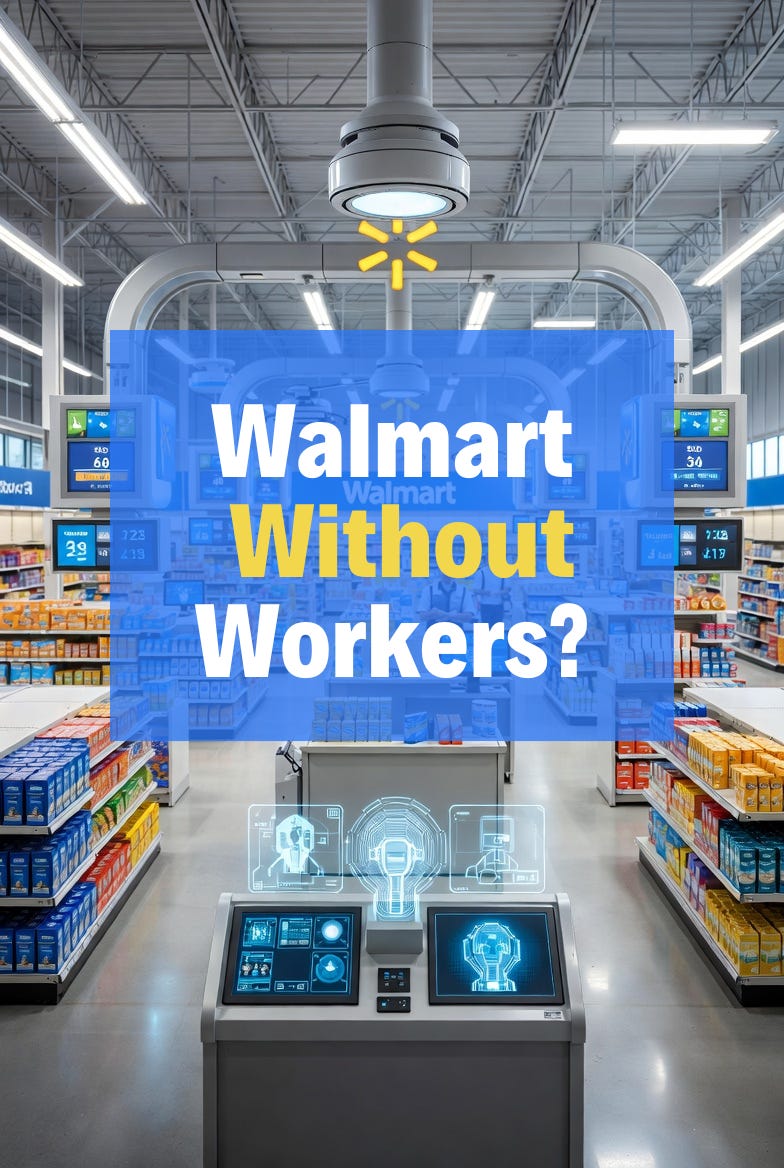
Walmart is the largest private employer in the United States. For decades, its operating model was linear meaning more stores, more volume, more people. That model has now been explicitly retired. Jaw drop… I know….
Revenue is rising, and so to is digital penetration, automation spend… yet headcount is not and it is all about demand.
Over the past two decades, Walmart’s workforce composition has shifted away from human judgment including management, supervision, and project coordination… and has focused heavily on execution increasingly mediated by software.
Walmart’s EVP of AI Transformation explained this in plain language too. I couldn’t take notes fast enough as he spoke.
Read literally…. not optimistically… because this is one of the clearest labor signals a Fortune 1 company has ever given.
Is this the end of hiring as a growth input?
I wanted to focus this as a piece about labor relevance.
To understand what Walmart is doing, you have to stop listening for buzzwords and start listening for control logic and their ideas of risk execution here.
Daniel Danker, Walmart’s Executive Vice President of AI Transformation, Product, and Design, was unusually explicit about the future operating model. Asked what a Walmart store looks like ten years from now, he did not talk about fewer people. He talked about where decisions live.
“The associates that are there all have a device that has an AI agent that powers their entire day.”
WOW.
“This agent is doing everything from helping them help customers… to telling them what the best next thing you can do is.”
That sentence is the story. Seriously.
Historically, deciding the best next thing to do was the job. That is why retail required layers of department managers, assistant managers, shift leads, floor supervisors. Retail is volatile. Shelves empty unpredictably…. well they used to anyways… Someone had to continuously reprioritize labor.
Walmart has now embedded that function into software.
Danker gave a concrete example:
“If there’s a spill on Aisle Five… it will literally kick in and say, ‘Actually, I need to reroute you.’”
Talk about command and control logic.
Once software assigns priority, sequences tasks, and dynamically reroutes labor, the economic justification for store-level middle layers just evaporates. You do not need as many people whose job is to decide what matters next if the system already knows.
This is how labor disappears without layoffs. Welcome 2026.
Walmart does not need to fire supervisors en masse. It simply stops replacing them. Attrition does the work. Over time, roles collapse into flatter execution bands. Judgment migrates upstream into centralized systems.
The workforce data I’m looking at already confirms this pattern and they haven’t really kicked this into gear yet.
Looking at Walmart job flows since 2003, growth in business management and program / project management roles is negligible relative to total employment. These categories account for well under one percent of net job creation over more than two decades. Operations roles grow, but slowly… and increasingly as a percentage of a largely static base.
This is not an accident.
The middle layer of the workforce is the product being sunset.
Most automation narratives focus on frontline displacement - but that is a distraction and probably one they hoped for.
Walmart is not starting by eliminating cashiers or shelf stockers. It is eliminating the reason those workers ever needed managers.
Store level middle layers exist to resolve conflicts between tasks and they allocate labor under uncertainty.
When Danker describes Walmart’s associate agent, he is describing the removal of that function.
The agent does not just answer questions about inventory… it monitors depletion rates, knows inbound truck schedules and it evaluates urgency. It reprioritizes work mid-task.
Those were management decisions but once encoded in software, they do not come back.
This is why Walmart can cap global headcount around 2.1 million and still expect to grow. Middle layers are cost-dense and judgment-heavy. Removing them produces immediate operating leverage without touching frontline execution.
The effect is subtle but permanent.
Overall, retail has historically been the labor sponge of the U.S. economy. When manufacturing shed workers, retail absorbed them. When services slowed, retail absorbed them. Walmart itself played that role for decades.
That era is ending.
Execution-only labor does not scale with revenue. It scales with square footage. Once stores are optimized, incremental growth flows through throughput, automation, and software… not people.
Walmart’s leadership is saying this plainly. They are not promising job growth because they no longer need it.
This matters far beyond Walmart.
If the largest private employer in the country can grow without adding workers, the benchmark for a “healthy” labor market changes. Productivity decouples from hiring. Expansion no longer requires absorption.
The result is not mass unemployment overnight. It is chronic under-absorption. Fewer ladders and more people competing for execution roles with less internal mobility.
That is the workforce signal embedded in Walmart’s strategy.
At roughly $130 per share, Walmart trades near its highs with a valuation multiple that increasingly reflects technology-like expectations: sustained margin improvement, operating leverage, and efficiency gains driven by automation rather than labor expansion.
The Q3 2025 bull case was straightforward: store-level automation replaces incremental hires, efficiency metrics improve as the labor mix tightens, and Walmart earns a higher multiple for discipline.
That case largely played out.
The question now is whether the market is pricing only the upside.
From a workforce perspective, Walmart’s strategy supports margins in the medium term. Fewer middle layers reduce fixed labor costs, centralized decision logic reduces variance and execution labor becomes more interchangeable.
But we must remember that thinner labor systems are also more brittle.
When judgment is centralized, local adaptability declines and errors can propagate faster. Training and churn costs rise at the execution layer. Political and regulatory scrutiny intensifies as absorption capacity falls. I’m not seeing this for now… but that is now.
A pullback into the low-100s would not contradict the thesis. It would reflect a bit of digestion…. or indigestion depending on what side you sat on…. with investors reassessing how much efficiency is already priced in versus how much execution risk remains.
The question should be: Does Walmart see themselves as a TECH company now?
Walmart leadership does not say this explicitly. But the language they are all using is pretty darn telling.
Danker described “four super agents” coordinating “too many nano agents to count.” He framed the future in terms of architectures, orchestration, and control layers…. not people.
That is how technology companies talk.
Walmart is not trying to be Silicon Valley of course, but it is doing something more consequential that we have not seen before in such a meaningful way… they are absorbing technology into the core of labor allocation.
Will millions of people still work for Walmart in ten years?
The wrong question is whether jobs exist.
The right question is how many humans are still required once judgment, prioritization, and exception handling are no longer human bottlenecks.
Walmart is answering that question now. Explicitly… and pretty much ahead of almost everyone else.
Is labor still going to be relevant?
Once the largest employer in the United States proves it works, it will not remain unique to Walmart.
Amanda Goodall
Get more workforce intelligence and risk execution reports.
I spent my summer (1993) before college helping expand a Walmart on three sides to turn it into a Super Center. Every department had a manager or assistant manager, and one was typically on the floor working. Our store had five assistant managers, all college-educated, and 3 or 4 were hired directly out of college and were under 30. At least a couple of old timers retired that summer with a million dollars in WM stock. How the times have changed.